
What Does a Backyard Pond Cost in the Willamette Valley?
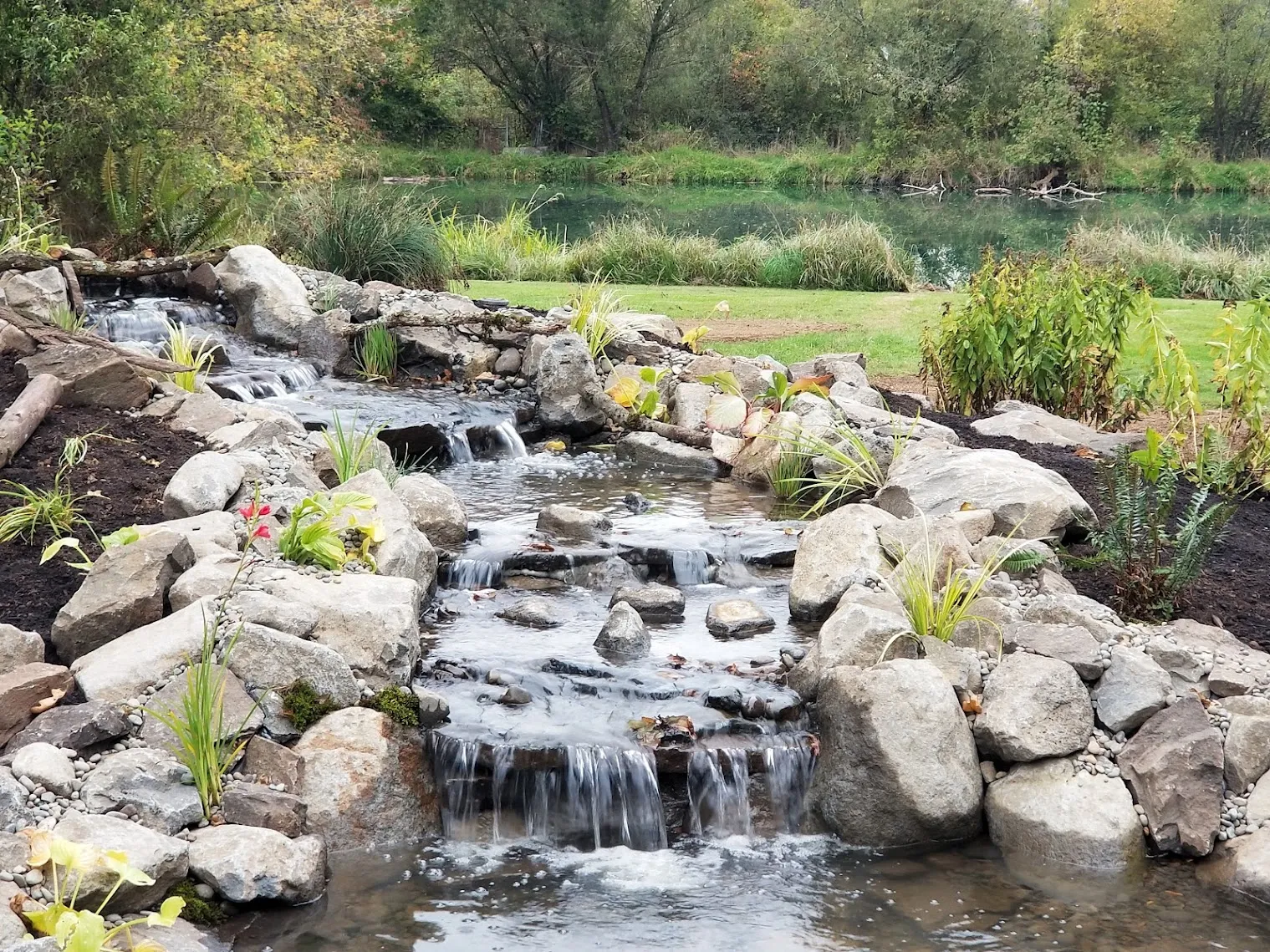
“What does a pond cost?” is the first question on every site visit, and it deserves a straight answer — not “it depends” and a clipboard. So here are real numbers, with the honest caveat that every pond gets quoted after we’ve walked your actual ground.
The short answer
- A bubbler rock or fountain — drilled stone or an urn recirculating over a hidden basin — starts around $5,500.
- A pondless waterfall or compact courtyard feature — moving water, no open pond — typically starts around $8,500, give or take.
- A backyard koi pond or watergarden — the classic build, with biological filtration, rockwork, and plants — mostly lands between $14,000 and $25,000.
- Larger natural ponds and estate-scale features — acreage builds with streams, wetland filtration, or serious excavation — start around $50,000 and scale with the ambition.
If those brackets feel wide, that’s because they’re honest. Here’s what each feature actually is, who it fits, and what quality looks like when you’re comparing builders.
The features, one by one
Bubbler rocks and fountains — start around $5,500
The simplest way to bring water into a garden: a drilled basalt column bubbling from its crown, or an urn or fountain recirculating over a hidden basin. No open water at all — safe where kids and pets roam — with the sound and movement at patio scale, and almost nothing to maintain. Quality markers: a properly sized hidden basin, and stones set solid so they never shift. The water itself gets aimed where it looks best from where you’ll actually sit — sometimes deliberately favoring one side of the stone. And add a low-voltage accent light: a bubbler at night is a different feature entirely.
Pondless waterfall — starts around $8,500
A waterfall and stream that vanish into a gravel basin and recirculate from a hidden reservoir — the sound and movement of water with no open pond. It fits courtyards, entries, and tighter lots, wants very little upkeep, and there’s no standing water to worry about. Quality marker: the hidden basin sized right for the water in motion — an undersized basin starves the pump every time the falls run hard.
Koi pond or watergarden — most land between $14,000 and $25,000
The classic ecosystem build: rock and gravel over quality liner and underlayment, plants doing real filtration work, and depth enough for fish to overwinter outdoors. A stream or waterfall isn’t an add-on here — it’s designed and priced as part of the pond, one number for the whole feature. What separates a quality build: filtration sized for the fish you’ll actually keep, and edges that hold their line over the years — settled edges are behind most of the “mystery leaks” we get called to find.
Estate and natural ponds — start around $50,000
Acreage builds: serious excavation with our own track hoe, long stream runs, wetland filtration, water shaped to the land. These scale with the ambition, and they’re the builds where thirty years of experience earns its keep.
The upgrades that transform a build
- Wetland filter — starts around $6,000, depending on feature size and design. Nature’s own filtration, built into the pond: water rises up through a planted gravel bed where beneficial bacteria and plant roots strip out the nutrients algae feeds on, then returns to the pond clean. Once planted, it reads as a lush garden bed at the water’s edge — you’d never guess it’s the hardest-working part of the system. A mini bog is the compact version of the same idea.
- Negative edge — starts around $5,000, depending on feature size and design. Water slides over a vanishing edge into a hidden basin and recirculates — the infinity-pool effect, done in natural stone. Dramatic on slopes and anywhere there’s a view to borrow.
The five things that move the number
- Size and depth. Not linearly — a pond twice the size isn’t twice the price, but depth adds excavation, liner, and rock fast. Fish that overwinter outdoors need adequate depth, and we build for that.
- Access. If our track hoe can drive to the hole, digging is quick. If everything moves through a 36-inch gate by hand and wheelbarrow, labor climbs. This is the most common surprise on in-town lots.
- Rock. The difference between a pond that looks built and one that looks born is largely stone — quantity, size, and how it’s placed. Boulder work is where the character comes from, and where a real chunk of the budget goes.
- Filtration. We build biological systems — the pond largely cleans itself, the way nature does. Done right, it costs more up front than a bare-bones pump-and-spitter and repays you every season in water quality and reduced fuss.
- What the water does. A still watergarden is one price. Add a stream run, a waterfall drop, or multiple falls and you’re adding plumbing, pumps, and rockwork.
Why the cheap pond costs more by year three
We rebuild other people’s ponds regularly, and the story is usually the same: a thin liner with no underlayment, filtration sized for the brochure instead of the fish load, rock set in ways that let edges slump. The result is green water, mystery leaks, and a rebuild that costs more than building it right would have. A well-built pond, by contrast, actually improves with age — the ecosystem matures, the stone settles in, and the maintenance gets easier, not harder.
Choose a builder who also maintains
Here’s a filter that will serve you well when comparing builders: ask who maintains their ponds. We run a full water-feature maintenance service — spring cleanouts, seasonal care, repairs — on our own builds and everyone else’s. Years of servicing ponds teaches you exactly what works and what fails, and that knowledge flows straight back into how we build. Frankly, a pond builder who doesn’t offer maintenance service shouldn’t be on your shortlist for a build. A water feature is more than a hole in the ground that holds water — it’s a designed, functioning ecosystem, and you want your builder to be your long-term confidant for ongoing care, troubleshooting, and service work, not a crew that disappears after the last rock is set.
A word on pumps — and why you don’t have to become an expert
The pump is the heart of the feature, and choosing one is more involved than the box at the hardware store suggests: flow matched to the pond’s turnover and the width of the falls, head height (how far up the water has to climb), energy draw over months of continuous running, submersible versus external, and how it sits in the skimmer or vault for service access down the road. Get it wrong and you’re buying green water, starved falls, or a surprising power bill. That’s part of what you’re paying a professional for — we spec it, install it, and service it, and when it ages out years from now, a pump swap is routine service work, often handled during a cleanout.
What it costs to keep
Budget for an annual spring cleanout — billed time and materials, so you pay for what your pond actually needs that season; most run $500–$2,800 depending on pond size, filtration type, and how the winter went. We can also deliver a curated season’s worth of maintenance products to your door the day we service the feature. Beyond that, a healthy biological pond mostly wants observation, seasonal plant care, and an occasional hand from us when something needs attention.
Getting a real number
Estimates are free. We’ll walk the property with you, talk about how you want to live with the water, and quote your actual pond — not a template. Call (503) 678-7744 or send the request form; we respond in 2–4 business days.